

Ontario Stunt Driving Charge: Penalties, Process & Defence Options
Charged with stunt driving in Ontario? This is not a regular speeding ticket. You may already be dealing with a 30-day licence suspension, 14-day vehicle impoundment, a summons to court, and the risk of much more serious penalties if convicted.
X-COPS helps drivers across Ontario fight stunt driving charges involving excessive speed, 150 km/h or more, racing allegations, aggressive driving allegations, roadside suspensions, vehicle impoundments, disclosure, police notes, radar, LIDAR, and court appearances.
Your case can be reviewed by a stunt driving lawyer or licensed paralegal who understands Ontario traffic court procedure, stunt driving evidence, prosecutor negotiations, and defence preparation.
Do not wait until your first court date to understand your options. Contact X-COPS for a free consultation about your stunt driving charge in Ontario.
Stunt Driving Lawyer Ontario: How X-COPS Can Help
A stunt driving case often depends on details that are not obvious from the summons alone. The alleged speed, the posted speed limit, the officer’s notes, the speed-measuring evidence, the location, the driving behaviour, and the court process can all affect the defence strategy.
X-COPS can help with:
- reviewing your summons and court documents;
- requesting and reviewing disclosure;
- examining police notes, radar, LIDAR, pacing, video, or other speed evidence;
- checking whether the allegation is based on speed, racing, driving behaviour, or another stunt-driving category;
- identifying possible weaknesses in the prosecution’s evidence;
- negotiating with the prosecutor where appropriate;
- preparing the case for trial if a reasonable resolution is not available.
The goal is not to guess whether the charge can be reduced. The goal is to understand the evidence before you make decisions that may affect your licence, insurance, job, and driving record.
What Happens When You Are Charged With Stunt Driving in Ontario?
When you are charged with stunt driving in Ontario, the first consequences usually happen at the roadside.
Police can impose:
- a 30-day driver’s licence suspension;
- a 14-day vehicle impoundment.
These roadside penalties apply immediately and do not depend on whether you are later convicted.
After that, the matter proceeds by summons. This means you will have a court date and must decide how to respond to the charge. It is not an ordinary speeding ticket that can simply be paid and forgotten.
At this stage, the key issue becomes what the charge is based on: speed, racing, driving behaviour, or another category of stunt driving. That matters because the evidence and defence options can be different in each case.
What Is Considered Stunt Driving in Ontario?
Under section 172(1) of the Highway Traffic Act, stunt driving in Ontario is not just about street racing or showing off behind the wheel. The law also covers excessive speed, contests, loss of traction, unsafe manoeuvres, and other driving behaviour listed under Ontario Regulation 455/07.
For regular drivers, the most common reason for a stunt driving charge is speed. Police may charge you with stunt driving if they allege that you were driving:
- 40 km/h or more over the speed limit where the posted limit is under 80 km/h;
- 50 km/h or more over the speed limit where the posted limit is 80 km/h or higher;
- 150 km/h or more, regardless of the posted speed limit.
However, stunt driving in Ontario is broader than speed alone. A driver may also be charged for conduct such as:
- racing or attempting to race another vehicle;
- driving in a contest of speed;
- driving in a way that shows an intention to chase another vehicle;
- rapidly accelerating to outdistance another vehicle;
- repeatedly changing lanes near other vehicles to move through traffic faster;
- driving side by side with another vehicle where one vehicle enters an oncoming lane longer than needed to pass;
- intentionally causing tires to lose traction while turning, such as drifting, doughnuts, or burnouts;
- driving in a way that indicates an intention to spin the vehicle or make it circle without maintaining control;
- lifting some or all tires from the road surface, including motorcycle wheelies;
- driving while not sitting in the driver’s seat;
- driving with a person in the trunk;
- driving without due care, without reasonable consideration for others, or in a way that may endanger another person.
In simple terms, what qualifies as stunt driving in Ontario depends on what the officer says you did. For some drivers, the allegation is based only on speed. For others, it may be based on racing, lane changes, loss of traction, aggressive acceleration, or other driving behaviour.
That distinction matters. A speed-based stunt driving case may depend on radar, LIDAR, pacing, speed limit signs, officer notes, and whether the alleged speed meets the legal threshold. A behaviour-based case may depend more on what the officer saw, what was captured on video, road conditions, witnesses, and how the driving was described.
Before deciding how to respond, you need to understand exactly what police say constitutes stunt driving in your case, and whether the evidence supports that allegation.
How Fast Is Stunt Driving in Ontario?
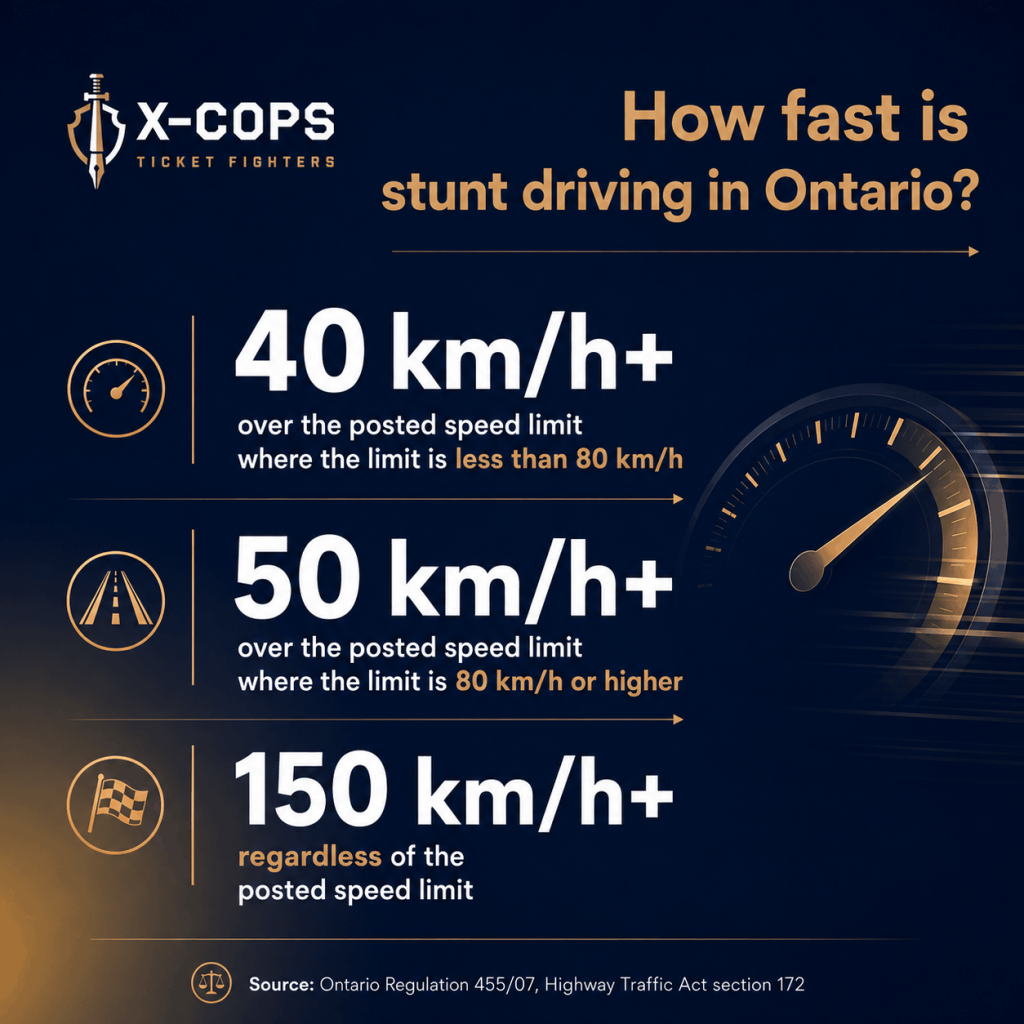
Ontario stunt driving speed depends on the posted speed limit and the speed police allege you were driving. The infographic below shows the main speed thresholds: 40 km/h over in zones under 80 km/h, 50 km/h over in zones of 80 km/h or higher, and 150 km/h or more regardless of the posted limit.
If you were charged with stunt driving because of speed, the defence often starts with one question: can the prosecution prove the alleged speed meets the legal threshold?
Ontario Stunt Driving Penalties
Stunt driving Ontario penalties are severe and escalate with each conviction. Some consequences apply immediately at the roadside, while others are imposed if the charge results in a conviction.
Ontario Stunt Driving Penalty, First Offence:
- immediate 30-day roadside licence suspension;
- 14-day vehicle impoundment;
- fine ranging from $2,000 to $10,000, plus a 25% victim surcharge;
- 6 demerit points;
- possible jail time of up to six months;
- licence suspension upon conviction ranging from 1 to 3 years;
- mandatory driver improvement course.
Penalties for Stunt Driving in Ontario, Second Offence:
- immediate 30-day roadside licence suspension;
- 14-day vehicle impoundment;
- fine ranging from $2,000 to $10,000, plus a 25% victim surcharge;
- 6 demerit points;
- possible jail time of up to 6 months;
- licence suspension upon conviction of up to 10 years;
- mandatory driver improvement course.
Stunt Driving Penalty Ontario, Third Offence and Subsequent:
- immediate 30-day roadside licence suspension;
- 14-day vehicle impoundment;
- fine ranging from $2,000 to $10,000, plus a 25% victim surcharge;
- 6 demerit points;
- possible jail time of up to 6 months;
- lifetime driver’s licence suspension upon conviction;
- mandatory driver improvement course.
The mandatory driver improvement course must be completed within 60 days of conviction. Failure to do so can result in further licence consequences.
Fully licensed and novice drivers are subject to the same stunt driving penalties in Ontario. However, novice drivers, including G2 drivers, may face additional licence consequences upon conviction.
Failure to pay fines associated with a stunt driving conviction will result in an automatic driver’s licence suspension.
A stunt driving conviction can have serious insurance consequences. Many drivers lose access to standard insurance markets and must seek coverage through high-risk insurers instead. Even where coverage remains available, premiums often become much more expensive after a conviction.
Is Stunt Driving a Criminal Offence in Ontario?
No, stunt driving is not a criminal offence in Ontario. It is prosecuted under provincial law, not the Criminal Code. That said, the consequences can still be severe. A conviction may result in significant fines, lengthy licence suspensions, possible jail time, and mandatory driver improvement courses.
Can You Fight a Stunt Driving Charge in Ontario?
Yes. A stunt driving charge in Ontario can be fought.
Fighting a stunt driving ticket in Ontario is not just about deciding whether to go to trial. The first question is how you want to deal with the case at all.
In practical terms, most drivers have three options:
- deal with the charge themselves;
- work toward a resolution in court;
- hire a stunt driving lawyer or licensed paralegal to review the evidence and handle the case.
Which option makes sense depends on the file. Some stunt driving cases may be better suited for negotiation. Others may have evidence issues that should be challenged more aggressively.
That usually becomes clear only after disclosure is requested and reviewed. Because stunt driving proceeds by summons and the penalties can be severe, it is usually worth getting legal advice before taking a position on the charge.
How to Fight Stunt Driving in Ontario: Step-By-Step Process
Fighting a stunt driving charge in Ontario is not the same as fighting a regular speeding ticket. A stunt driving charge is issued by summons, which means the case must go through court. You cannot simply pay the ticket and move on.
The goal is to review the evidence, understand what the prosecution must prove, and decide whether the charge should be challenged, negotiated, reduced, or prepared for trial.
1. Attend the First Court Appearance
The date on your summons is usually not the trial date. It is the first appearance, where the matter is formally brought before the court and the next steps are scheduled.
At this stage, disclosure may be confirmed or requested, and future court dates may be set. If you do not attend and no one appears for you, the court may proceed in your absence. In some cases, a bench warrant may be issued.
2. Request and Review Disclosure
Disclosure is the evidence the prosecutor intends to use against you. In a stunt driving case, it may include police notes, radar or LIDAR evidence, pacing details, testing records, video, witness information, and observations about the alleged driving behaviour.
This stage is critical. Before deciding whether to negotiate, plead guilty, or proceed toward trial, you need to know what the evidence actually shows.
3. Analyze the Stunt Driving Allegation
The defence strategy depends on how the charge was laid:
- If the case is speed-based, the review may focus on whether the alleged speed meets the stunt driving threshold, how the speed was measured, whether the officer’s notes support the reading, and whether the speed evidence is reliable.
- If the case is behaviour-based, the review may focus on whether the evidence actually proves racing, loss of traction, aggressive driving, chasing another vehicle, or another stunt-driving category.
Possible issues may include incomplete notes, unclear speed evidence, missing testing information, weak observations, identification issues, or procedural problems.
4. Discuss Resolution With the Prosecutor
After disclosure is reviewed, the case may move to resolution discussions or a Crown pre-trial. This is where the evidence, weaknesses, driver’s record, and possible outcomes are discussed.
In some cases, a stunt driving charge may be reduced to a less serious offence. In other cases, the evidence may support a request for withdrawal. Neither result is automatic. It depends on the facts, the prosecutor’s position, the court location, and the strength of the case.
5. Prepare for Trial if Needed
If no reasonable resolution is available, the case may need to proceed toward trial. At trial, the prosecutor must prove the charge, the officer may testify, and the defence may challenge the evidence through cross-examination and legal argument.
Not every case goes to trial, but every serious stunt driving case should be reviewed as if trial may become necessary.
At X-COPS, we review the summons, disclosure, police notes, speed evidence, driving allegation, and court process before advising whether the case is better suited for negotiation, reduction, challenge, or trial preparation.
Do You Need a Stunt Driving Lawyer or Licensed Paralegal?
Legal representation is not mandatory for a stunt driving charge in Ontario. You can represent yourself.
However, many drivers get legal help because stunt driving cases involve court appearances, disclosure review, speed evidence, prosecutor discussions, possible trial preparation, and serious penalties if convicted.
A stunt driving defence lawyer or licensed paralegal may be especially important if:
- you drive for work;
- you are a novice or G2 driver;
- the alleged speed is high;
- the charge involves racing or aggressive driving allegations;
- you have prior convictions;
- you cannot risk a long licence suspension;
- you are worried about insurance consequences;
- your job depends on your ability to drive.
You can deal with the charge yourself, but you are also responsible for understanding the evidence, speaking with the prosecutor, making court decisions, and preparing for trial if the matter gets that far.
When the outcome may affect your licence, insurance, work, or driving record, getting the file reviewed early can help you avoid costly mistakes.
Mistakes to Avoid After Being Charged with Stunt Driving
After being charged with stunt driving in Ontario, early mistakes can make the case harder to deal with later.
Avoid:
- driving during the 30-day roadside licence suspension;
- ignoring the summons or missing your court date;
- pleading guilty before reviewing disclosure;
- assuming the charge will automatically be reduced;
- treating the charge like a regular speeding ticket;
- waiting until the trial date to get legal advice.
A stunt driving charge moves through court, and the evidence should be reviewed before you decide how to respond. The earlier X-COPS reviews the file, the easier it is to understand the risks, possible weaknesses, and whether the case should be negotiated, challenged, or prepared for trial.
Speak With a Stunt Driving Lawyer in Ontario
If you have been charged with stunt driving in Ontario, do not wait until the case moves further through court. The earlier the file is reviewed, the easier it is to understand the evidence, the risks, and the possible stunt driving defence options.
X-COPS helps Ontario drivers fight stunt driving charges involving excessive speed, racing allegations, roadside suspensions, vehicle impoundment, summonses, disclosure, radar, LIDAR, and court appearances.
Call X-COPS today for a free consultation about your stunt driving charge.
X-COPS helps drivers with stunt driving charges across Ontario, including Toronto, Mississauga, Brampton, Scarborough, Ottawa, Hamilton, Barrie, London, Vaughan, Newmarket, and nearby areas.