

Every year, thousands of drivers are charged with impaired driving in Ontario, facing stiff impaired driving penalties – from huge fines to long licence suspensions and even jail time. It’s no surprise the first question we hear is, “What are my chances of winning a DUI case in Ontario?” and “What percentage of DUI cases get dismissed?”
Here’s the good news: recent figures from Statistics Canada show that approximately 60-62% of impaired-driving cases in Ontario end without a conviction. In other words, the odds of winning a DUI case in Ontario are better than a coin flip – provided you and your lawyer know where the Crown’s case can crack.
Below, we show you where those weak links usually hide and how the right defence strategy can turn today’s favourable statistics into your personal win.
DUI Stats in Ontario
But first, let’s take a look at the data on DUI cases in Ontario. The following table shows how many DUI cases were dismissed in Ontario, guilty convictions, acquittals, and cases stayed or withdrawn for the period from 2015/2016 to 2023/2024 (latest stats available):
| Fiscal Year | Total Decisions | Guilty Convictions | % Guilty | Acquittals | % Acquitted | Stayed or Withdrawn | % Stayed or Withdrawn |
|---|---|---|---|---|---|---|---|
| 2015/2016 | 23,592 | 11,199 | 47.47% | 449 | 1.90% | 11,788 | 49.97% |
| 2016/2017 | 23,880 | 11,264 | 47.17% | 422 | 1.77% | 12,069 | 50.54% |
| 2017/2018 | 23,435 | 11,039 | 47.10% | 444 | 1.89% | 11,826 | 50.46% |
| 2018/2019 | 20,863 | 9,907 | 47.49% | 434 | 2.08% | 10,444 | 50.06% |
| 2019/2020 | 22,302 | 10,965 | 49.17% | 349 | 1.56% | 10,824 | 48.53% |
| 2020/2021 | 15,037 | 5,649 | 37.57% | 192 | 1.28% | 9,117 | 60.63% |
| 2021/2022 | 23,436 | 9,611 | 41.01% | 249 | 1.06% | 13,473 | 57.49% |
| 2022/2023 | 27,747 | 10,071 | 36.30% | 290 | 1.05% | 17,299 | 62.35% |
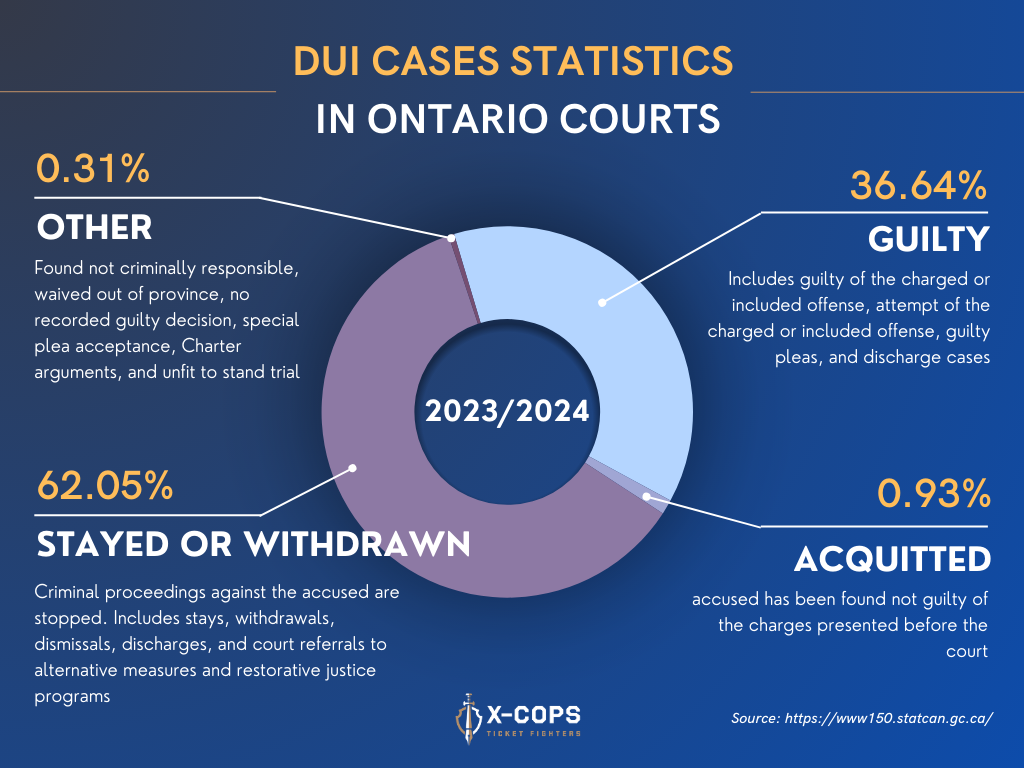
| 2023/2024 | 28,681 | 10,506 | 36.64% | 268 | 0.93% | 17,791 | 62.05% |
Source: Statistics Canada, Table 35-10-0027-01 (Adult Criminal Courts, Ontario)
Key Takeaways on Recent DUI Stats in Ontario 2015-2024:
- More DUI cases now end without a conviction than with one.
From 2015 to 2019, about 52% of impaired-driving cases in Ontario were resolved without a conviction. Since 2020, that figure has increased and remained consistently above 60%, reaching nearly 63% in 2023-2024. - The post-COVID shift has held & it wasn’t a one-year spike.
While court backlogs during the pandemic initially forced prosecutors to drop weaker cases, the elevated stay-and-withdrawal rates continued even after court volumes recovered. This points to a lasting change in prosecution strategy, not a temporary distortion. - Convictions declined even as courts processed more cases.
Between 2020-21 and 2023-24, total DUI decisions rose sharply, yet conviction rates fell into the mid-30% range. Increased enforcement has not produced higher conviction rates, suggesting that more cases are being screened out before trial. - Most successful outcomes happen before a verdict.
Acquittals remain rare, consistently under 2%. The majority of favourable results come from stays and withdrawals, typically triggered by Charter violations, disclosure gaps, or evidentiary weaknesses identified early in the process. - Procedure now matters more than test results alone.
Despite improved breath-testing technology, DUI cases most often collapse due to police-procedure issues, such as unlawful stops, delayed access to counsel, or missing maintenance records, not because of borderline BAC readings. - Statistics favour prepared defences, not automatic wins.
While current data shows that avoiding a conviction is more common than many drivers expect, outcomes still depend on the facts of each case. The advantage lies with defendants who uncover procedural flaws early and apply a focused legal strategy.
What Percentage of DUI Cases Get Dismissed in Ontario?
Recent Ontario court data shows that about 58-62% of DUI charges are stayed or withdrawn, with rates consistently above 60% since 2021. While results vary by case, avoiding a DUI conviction is now more common than many drivers expect.
Chances of Winning a DUI Case in Ontario
Impaired-driving charges are decided in Ontario’s criminal courts, and every case turns on its own facts, police procedure, and Charter compliance. Still, recent court data shows that the chances of winning a DUI charge in Ontario are stronger than many drivers expect.
Latest fiscal year (2023-2024)
Approximately 62% of DUI cases did not result in a conviction:
- 62.05% were stayed or withdrawn
- 0.93% ended in an acquittal
- 36.64% resulted in a guilty finding
Long-term trend:
Before COVID (2015-2019), roughly 52% of DUI cases ended without a conviction. Since 2020, the chances of winning a DUI charge in Ontario have improved noticeably, with non-conviction rates consistently remaining above 60%, signalling a lasting shift rather than a temporary spike.
X-COPS experience:
Across the past 200 DUI files closed by X-COPS, roughly seven in ten clients avoided a criminal record, slightly outperforming the provincial average due to early Charter screening and focused pre-trial negotiations.*
*Internal case audit, 2024-2025. Results depend on the facts of each case
⚠️ Reality Check:
- Counting raw percentages is useful, but it can’t predict your outcome.
- Every stop, breath test and Charter issue is unique.
- A single missing maintenance log can flip a “sure conviction” to a stay.
Bottom line: Stats point to better odds than a coin-flip – yet the real decider is the strength of the evidence and the strategy applied to it. A tailored legal review is the only way to know where you stand when beating a DUI case in Ontario.
What “Winning a DUI Case” Looks Like in Practice
- Stay or withdrawal – the clean win: When a Charter breach surfaces – such as an illegal stop, a delayed right-to-counsel call, or missing paperwork – the Crown will often agree to have the DUI charges dropped. The file ends right there: no criminal record, no fine, and no licence suspension. But it depends on the severity of the issue and societal interest too.
- Downgrade to a traffic offence – the quiet win: When the evidence isn’t rock-solid, we can often negotiate a DUI reduction to careless driving under the Highway Traffic Act. You’ll face a smaller fine and a brief licence suspension, yet still sidestep a Criminal Code record and the sky-high insurance premiums that come with it.
- Full acquittal – the dramatic win: A judge rules “not guilty” at trial. Satisfying, but rare – about 1% province-wide because weaker cases are usually stayed or bargained down long before verdict.
- Sentence-softening – the damage-control win: Even with strong evidence, persuasive advocacy can trim jail time, shorten licence suspensions or secure house arrest. A record remains, but life disruption is reduced.
Factors That Affect the Chances of Winning a DUI Case in Ontario
Even with a 60-62% province-wide non-conviction rate, your likelihood of winning a DUI case still rides on five core factors:
- Quality of the Crown’s evidence: Bad camera angle? Any inconsistency weakens the file and pushes it toward a stay or downgrade.
- Skill of your DUI lawyer: A seasoned DUI lawyer knows where to probe – Charter timing, Intox EC/IR II records, disclosure gaps – and how to leverage those cracks at a Resolution Meeting or in court.
- Police procedure on the night: Illegal stop, delayed right to counsel, sloppy roadside notes – each one can trigger an evidence exclusion and sink the prosecution.
- Your driving record: Prior convictions tighten the margins but don’t erase them – Charter breaches still win cases.
- Mitigating facts: Medical emergencies, mouth-alcohol interference, equipment malfunctions, or even a spotless community record can all tip sentencing – or the charge itself – back in your favour.
Is It Worth Fighting a DUI in Ontario?
Almost always, yes. A conviction locks in a criminal record, steep fines, a one-year (or longer) licence suspension, and higher insurance for years – see exactly how long DUI stays on your driving record.
Contesting a DUI charge lets us, as your counsel:
By contesting a DUI charge you can:
- Examine the Crown’s evidence closely. Flaws in maintenance, video, or Charter timing can render key proof inadmissible.
- Negotiate from a position of strength. Demonstrated weaknesses often prompt the Crown to stay, withdraw, or accept a plea to a non-criminal traffic offence.
- Limit long-term consequences. Avoiding a Criminal Code conviction reduces barriers to travel, employment, and affordable insurance.
Fighting does take time and some legal fees, and no one can guarantee success. But with an experienced DUI lawyer steering the strategy, the upside of a clean slate far outweighs the cost of mounting a defence.
Turning Statistics Into Your Personal Odds
The province-wide success rate for winning a DUI case in Ontario currently sits at about 62%, but your own odds soar only when a lawyer pinpoints the exact weakness – whether it’s a 25-minute counsel delay, a missing Intox EC/IR II calibration sheet, or a disclosure gap the Crown can’t cure.
Book a no-cost, 30-minute review with an X-COPS DUI lawyer today, and find out which of the wins above is realistically on the table for you!