

Ontario has changed how impaired driving cases are handled, especially what happens at the roadside.
The new impaired driving laws Ontario 2026 bring longer licence suspensions, stricter repeat-offender rules, tougher consequences for young drivers, and more penalties that apply immediately, not months later in court.
If you drive in Ontario, these changes affect you whether you’ve ever been charged or not.
Here’s a clear breakdown of what’s new and why it matters.
Lifetime License Suspension in the Most Serious Impaired Driving Cases
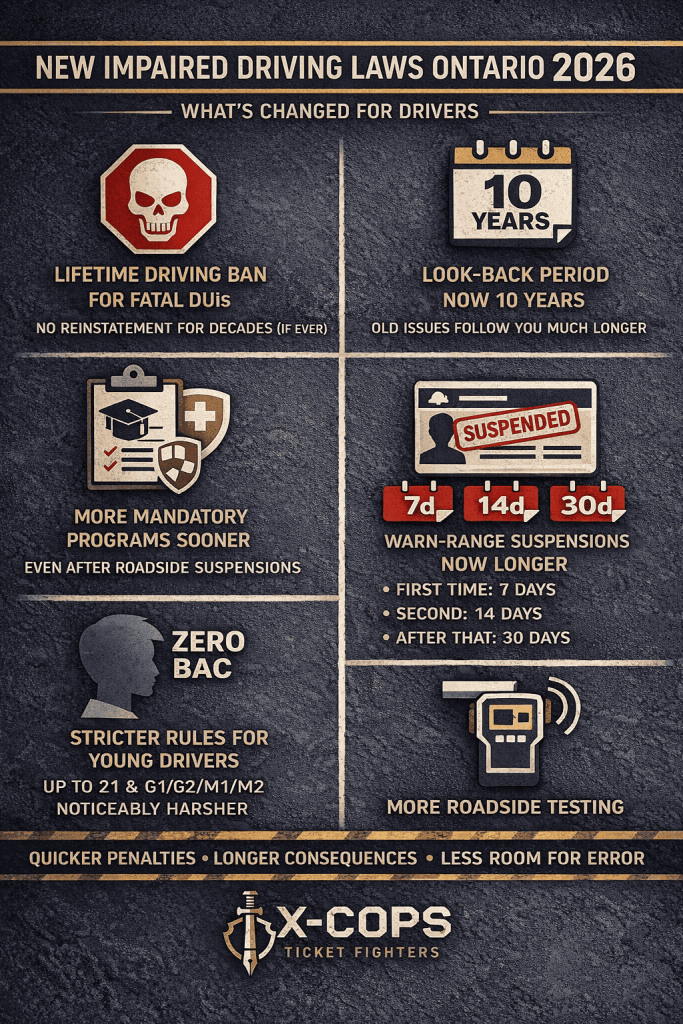
Ontario has taken a much harder stance on impaired driving cases involving fatalities.
In the most serious situations, a conviction for impaired driving causing death can now result in a lifetime provincial driving ban. In many cases, tIn many cases, there may be no realistic way to get driving privileges back for decades, if ever.
This consequence is separate from any court sentence and focuses on permanently removing high-risk drivers from the road.
Tougher and Longer Roadside Licence Suspensions
Ontario has increased the length of immediate roadside licence suspensions, especially for warn-range alcohol readings.
If police register a BAC in the warn range (typically 0.05-0.079):
- First offence: 7-day suspension
- Second offence: 14-day suspension
- Third+ offence: 30-day suspension
These suspensions are issued immediately, with no court process and no grace period. For many drivers, this is now the first and most disruptive consequence they experience.
If you’re unsure how warn-range readings work or how limits differ by licence type, this guide explains Ontario blood alcohol limits in plain language.
Ontario Now Looks Further Back at Your Driving History
One of the most impactful changes under the new impaired driving laws Ontario 2026 is the expanded look-back period. Ontario now reviews impaired-driving-related incidents going back up to 10 years, instead of 5.
This affects:
- licence suspension lengths
- ignition interlock requirements
- how incidents are classified (first vs repeat)
- education or treatment program requirements
A past issue that once had little impact can now significantly worsen the consequences of a new incident.
Education and Treatment Programs Trigger More Easily Than Before
Ontario has required education and treatment programs in impaired driving cases for years. That hasn’t changed. What has changed is how easily and how early these programs are now triggered.
Under the new impaired driving laws Ontario 2026:
- programs can be required after roadside suspensions, not just court outcomes
- drivers are pushed into programs earlier in the process
- a longer look-back period means more drivers are classified as repeat incidents
This matters because:
- repeat incidents are more likely to require treatment, not just education
- licence reinstatement can be delayed if programs are not completed
- requirements can apply before a criminal case is resolved
Programs haven’t become new – they’ve become harder to avoid.
Stricter Consequences for Young and Novice Drivers
Young and novice drivers continue to face zero-tolerance rules, but enforcement has become more impactful.
If you hold a G1, G2, M1, or M2 licence, or are under 21:
- any alcohol detection can result in a suspension
- prior incidents now follow you for up to 10 years
- penalties escalate faster on repeat issues
For young drivers, one mistake can:
- delay graduation to a full licence
- lead to long-term insurance problems
- affect driving privileges well into adulthood
Increased Roadside Testing Means Faster Consequences
Ontario continues to rely heavily on mandatory roadside alcohol screening. Police can demand a breath sample during any lawful traffic stop, even without suspicion. Drug-impaired driving enforcement has also expanded through roadside screening.
The result is simple:
- more testing
- more roadside suspensions
- more drivers facing consequences immediately
This enforcement approach is a key reason drivers now feel the impact of impaired driving laws sooner than before.
What Actually Changed: Quick Comparison
| Issue | Before | Now (2026) |
|---|---|---|
| Impaired driving causing death | Case-specific license suspension | Lifetime license suspension possible |
| Look-back period | 5 years | 10 years |
| Program triggers | Mostly post-court | Earlier & more often |
| First warn-range suspension | 3 days | 7 days |
| Second warn-range suspension | 7 days | 14 days |
| Young driver impact | Zero tolerance | Zero tolerance + longer reach |
This table shows what changed, but it doesn’t cover every possible outcome. For a full breakdown of fines, suspensions, programs, and licence bans, see our guide on impaired driving penalties in Ontario.
Don’t Let One Stop Decide Your Future
The new impaired driving laws Ontario 2026 make one thing clear: consequences now come faster, last longer, and are harder to undo.
A roadside stop can quickly turn into:
- a lengthy licence suspension
- mandatory programs
- ignition interlock requirements
- long-term insurance problems
Many drivers assume that once they’ve been stopped or charged, the outcome is already decided. In reality, every case turns on evidence, procedure, and timing. You can learn more about the chances of winning a DUI case in Ontario and what actually affects the outcome.
Every impaired driving case depends on:
- how the stop was conducted
- how testing was handled
- how evidence was collected
- and how early the case is properly addressed
If you’re facing a DUI charge or an impaired driving related suspension, getting the right advice early can make a real difference. X-COPS helps drivers fight impaired driving charge and protect their licence, record, and future.
If you want to understand what you’re up against and what your options really are, the best step is to speak with a team that deals with Ontario DUI cases every day. Because under today’s laws, waiting things out is rarely the safest move.